
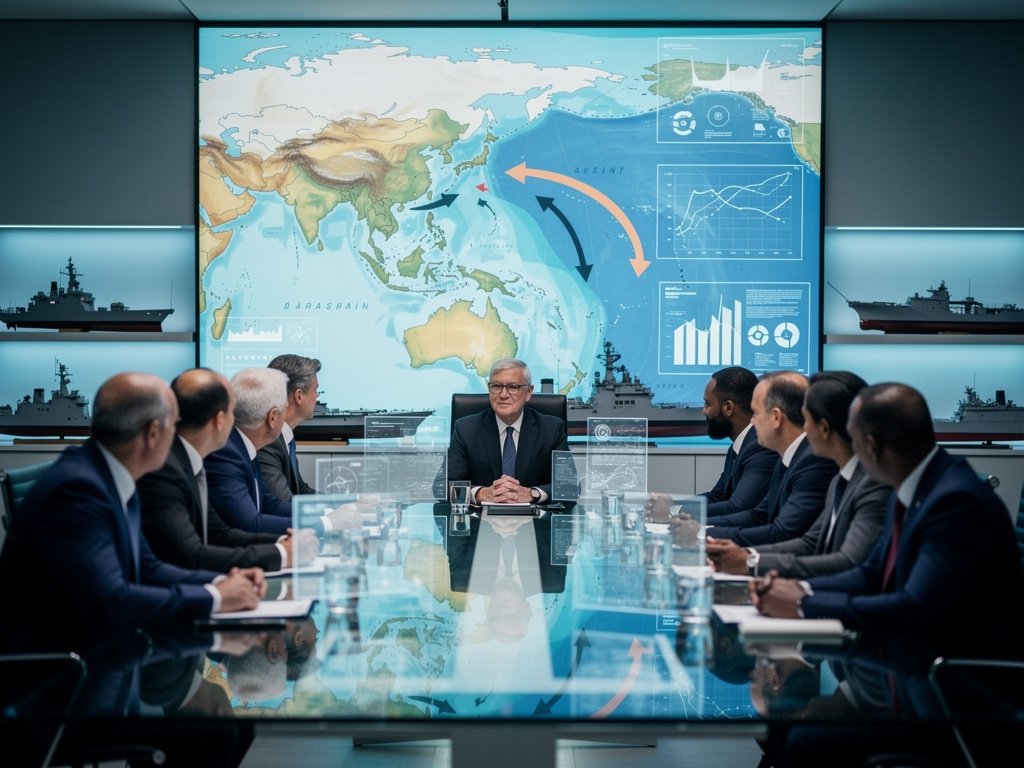
Indo-Pacific Deterrence Strategy Shifts With Colby Testimony
In his confirmation testimony, Elbridge Colby argued that China is the biggest, most powerful rival in about 150 years and urged a prioritised engagement and deterrence strategy for the Indo-Pacific. He called for rectifying an unfunded $11 billion Indo-Pacific Command priority list, signaling tighter resource discipline and a shift toward high-threat theaters along with a 'one-war' military concept. Colby warned against expansive, NATO-like regional architectures, pressed for tailored deterrence and stronger allied defense spending, noted potential AUKUS submarine constraints, and described how Australia and Pacific island states must adapt as the US reshapes its industrial base and alliances.
Background & Context
In the late 2010s, the United States reoriented its defense posture through the 2018 National Defense Strategy, shifting from the goal of global primacy to prioritised engagement aimed at denying China's hegemony in Asia. Elbridge Colby, a principal designer of that strategy, argues for a denial-based approach that compels Beijing to bear the costs of aggression while preserving U.S. freedom of action in the region. The framework also highlights the so-called Lippmann gap—the mismatch between strategic ends and the capabilities and resources needed to achieve them—and calls for aligning the industrial base with strategic aims, including enhanced shipbuilding and advanced munitions capacity.
Practically, this means examining the U.S. industrial base, shipbuilding capacity, and resource allocation, and determining how Indo-Pacific allies—particularly Australia and Pacific island nations—fit into a deterrence-focused architecture. USINDOPACOM coordinates planning with partners and leverages initiatives like AUKUS to accelerate access to advanced technologies, sustain maritime and air power, and strengthen deterrence in the Indo-Pacific region against potential coercion by China.
Allied concepts emphasize integrated deterrence—multiplying resilience through alliance networks, joint exercises, and defense-industrial collaboration—so relative American advantages in certain domains are preserved while diplomacy remains open. The debate also reflects how to fund and sustain capital-intensive capabilities amid contested budgets and evolving threat perceptions, without sacrificing deterrence credibility or alliance solidarity in the face of China's modernization of its armed forces.
Looking ahead, the discussion situates itself in a broader historical arc that includes the 2018 NDS and ongoing alliance development, with attention to questions such as "what are the chances of going to war with china" and "are we going to war with china". Diplomacy and deterrence are not mutually exclusive; credible pressure and resilient partnerships aim to maintain regional stability and prevent conflict.
Key Developments & Timeline
-
2018 — The National Defense Strategy, with Colby instrumental in shaping it, established a focused posture toward great-power competition in the Indo-Pacific. By foregrounding a resilient denial of adversaries’ aims and calling for disciplined resource allocation, this milestone framed China as a central strategic challenge. Colby’s influence helped set the tone for prioritised engagement, deterrence planning, and a shift toward strengthening allies’ defense capabilities to share deterrence burdens across the region.
-
2021 — Elbridge Colby publishes The Strategy of Denial, articulating a deterrence framework designed to prevent Beijing from achieving its objectives in the Indo-Pacific. He argues for tailored deterrence and selective coalitions rather than broad, NATO-like architectures, stressing tighter budgets and a clear alignment of ends and means to counter China.
-
March 2025 — Senate confirmation hearing for Under Secretary of Defence for Policy, featuring Colby’s testimony. He defends a 'one-war military and change' approach, urges allies to boost defense spending, and calls for a reallocation of resources toward high-threat theaters in the Indo-Pacific to sustain deterrence against strategic competitors such as China.
-
March 2025 — The Strategist publishes editors’ picks for 2025 summarizing Colby’s views on prioritised engagement and alliance burden-sharing, with notes on how the United States might adapt its partnerships in response to evolving security challenges. The piece reinforces the ongoing discourse on deterrence posture and how selective coalitions can shape regional stability in the era of strategic competition with China.
-
Late 2025 — Ongoing debates over prioritised engagement, alliance burden-sharing, and AUKUS submarine provisioning. The discussions reflect pressure on Australia to accelerate its defense buildup and for Pacific island states to navigate security guarantees and economic inducements, as policymakers consider how to mobilize an effective, selective coalition to deter strategic competitors in the region.
Official Statements & Analysis
In confirmation testimony, Colby stated that "China is ‘the biggest, most powerful rival we have faced in probably 150 years.’" He also warned that "we have a one-war military and change," signaling a shift toward prioritized engagement and tighter resource discipline. He described Australia as "perhaps our closest ally in the world" and argued for a strategy to build a "deny China" coalition, prioritizing engagement with allies rather than pursuing broad, NATO-like regional architectures. He also calls for rectifying an unfunded $11 billion Indo-Pacific Command priority list, signaling tighter resource discipline and reallocation toward high-threat theaters.
The statements matter because they foreground a high-geopolitical-risk environment in the Indo-Pacific and the need for tailored deterrence with increased defense spending. They imply allied burden-sharing, US industrial base capacity, and submarine deterrence will shape policy choices, including debates over AUKUS and the tempo of regional security commitments. Questions such as "what happens if we go to war with china" reflect concerns about security guarantees for Pacific island states and the economic and security trade-offs of any shift toward bilateral arrangements. In this context, the focus on china as a primary focal point and the call for a sustained “deny China” coalition underscore a strategic pivot toward selective, capability-focused partnerships and a recalibration of long-term military strategy.
Conclusion
Elbridge Colby's confirmation testimony highlights a shift toward prioritized engagement and stronger deterrence of China in the Indo-Pacific, reshaping how the US coordinates with Australia and Pacific island states amid AUKUS debates and questions about the US defense industrial base and china military capabilities. The core takeaway is that streamlined alliance risk-sharing and a focus on capabilities—especially submarine production and other defense capabilities—are likely to drive future planning and policy toward more targeted security arrangements rather than broad multilateral architectures. Looking ahead, the outlook points to intensified deterrence, greater allied spending, and a shift toward bilateral coalitions that better align with geography, while potential disruptions to supply chains and governance challenges remain under risk categories. In sum, the article invites readers to consider what happens if we go to war with china as the scenario unfolds and emphasizes the need for extended submarine production to meet deterrence needs, while reinforcing resilience across allied supply chains and crisis planning.
Gorilla Tape – Stronger than regular duct tape — Gorilla Tape holds fast in the worst conditions.
Compression Sacks – Save space in your bug-out bag with tough, compression-ready sacks.
Related: Trump Blames Ukraine for Russia-Ukraine War Amid Tensions
Related: Russia’s Massive Drone and Missile Assault Escalates Ukraine Conflict and NATO Tensions