
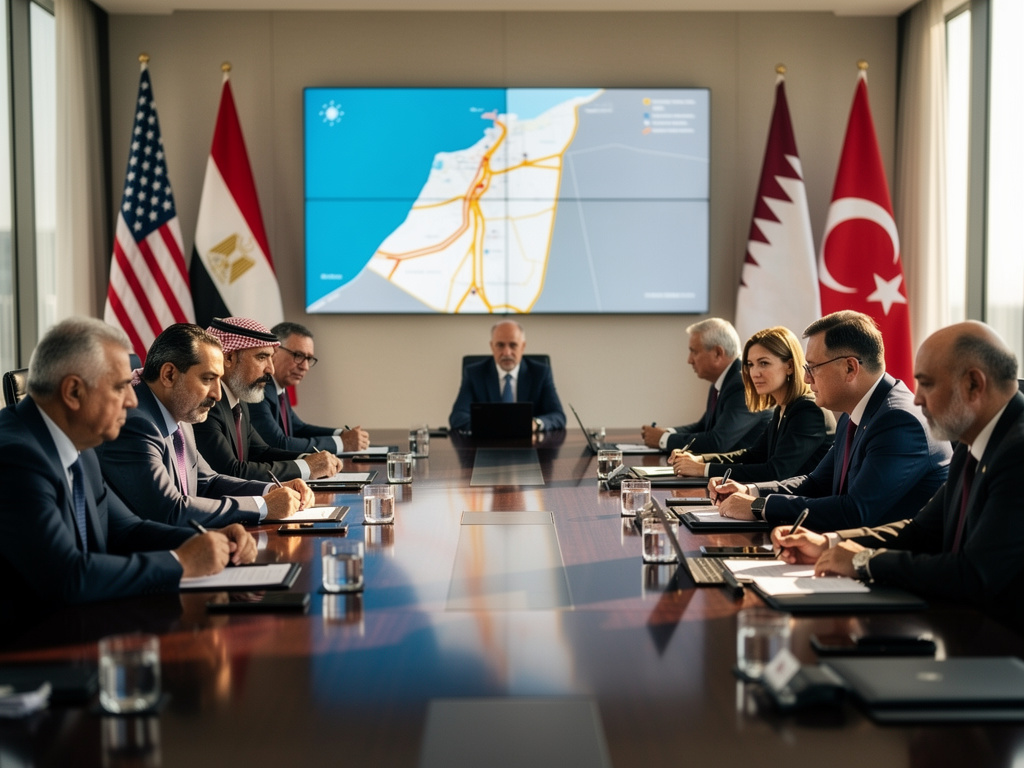
Gaza Ceasefire Talks Advance as Phase One Yields Progress
Negotiators from the United States, Egypt, Qatar and Türkiye urged restraint as Israeli operations in Gaza continued and reviewed the first phase of the Gaza ceasefire with Hamas, including monitoring arrangements for compliance. The first phase yielded progress on humanitarian aid, the return of captives’ bodies, partial Israeli withdrawals, and reduced hostilities, with plans for a second phase that could establish a transitional administration and possibly deploy an stabilisation force. Hamas said it remained committed to the ceasefire while calling for urgent relief ahead of the winter humanitarian crisis, even as Israeli strikes continued and diplomacy shaped next steps toward disarmament and Gaza governance.
Background & Context
- The Gaza ceasefire formalized a multi-stage framework to end broader hostilities between Israel and Hamas. The first phase, which began on October 10, expands humanitarian access, facilitates the return of abducted or captured bodies, and allows partial Israeli withdrawals, marking a cautious step toward reducing daily violence.
- The second phase contemplates governance arrangements via a transitional authority and the possible deployment of an international stabilisation force to support post-conflict stabilization and governance in the Gaza Strip.
- Winter conditions and Gaza's damaged infrastructure have intensified humanitarian concerns, with aid agencies reporting impediments to relief efforts due to restrictions, electricity shortages, and damaged water systems that complicate essential service delivery.
- Diplomatic discussions included meetings in Miami with the U.S. envoy reviewing the first phase, and Istanbul negotiations between Hamas negotiators and Turkish intelligence, all aimed at implementing the ceasefire and planning for a broader transitional administration and stabilization mechanisms.
- Important actors span several states and entities, including the United States, Egypt, Qatar, Türkiye, Israel, and the Palestinian Authority/Hamas, with figures such as Khalil al-Hayya and Ibrahim Kalin playing central negotiating roles.
- The arrangement seeks to balance immediate humanitarian relief with longer-term political arrangements, highlighting how international involvement may influence regional stability and the daily lives of civilians in Gaza.
- Analysts note that sustaining relief efforts will depend on continued adherence to the ceasefire terms, credible governance arrangements, and ongoing coordination among major international and regional partners to address evolving needs in Gaza.
Key Developments & Timeline
- October 10 — The Gaza ceasefire enters into effect in its first phase, yielding progress such as expanded humanitarian aid corridors, the return of some bodies from captives, partial Israeli force withdrawals from certain areas, and a noticeable reduction in hostilities.
- Recent Friday–Saturday discussions in Miami among mediator nations—the United States, Egypt, Qatar, and Türkiye—on the first phase and transition planning; participants urged all parties to honor commitments, exercise restraint, and cooperate with monitoring in the Gaza ceasefire process.
- In Istanbul, the Hamas negotiator Khalil al-Hayya met with Ibrahim Kalin, the Turkish intelligence chief, in a high-level engagement focused on next steps and regional coordination.
- Ongoing statements and monitoring regarding adherence to the 20-point peace plan and the potential formation of a transitional administration and stabilisation force; consultations on implementation are expected to continue to shape the roadmap.
- Hamas reiterated commitment to the ceasefire, met with Turkish intelligence, and highlighted urgent humanitarian needs for winter—tents, caravans, and heavy equipment—to address harsh seasonal conditions.
- Israeli operations persisted with strikes in northern Gaza and continued casualties; the Gaza Civil Defence reported dozens of bodies recovered and ongoing destruction of infrastructure and services.
- In parallel, US Secretary of State Marco Rubio signaled possible troop contributions to a stabilisation force and pressed for Hamas disarmament to prevent derailment of the plan, signaling broader international involvement.
Official Statements & Analysis
"We reaffirm our full commitment to the entirety of the President’s 20-point peace plan and call on all parties to uphold their obligations, exercise restraint, and cooperate with monitoring arrangements."
The delegation stressed the urgent need to halt these continuous violations, and the Gaza ceasefire remains a central objective guiding regional diplomacy.
"The delegation also reviewed the deteriorating humanitarian situation in the Gaza Strip with the onset of winter, emphasising the critical priority of urgently bringing in tents, caravans, and heavy equipment to save our people from death by cold and drowning," highlighting the mounting humanitarian pressure as cold weather compounds already strained aid corridors and underscoring the urgency of increasing shelter, warmth, and life-support supplies, winter conditions.
"Israel is supposed to withdraw from its positions in Gaza, an interim authority is to govern the Palestinian territory instead of Hamas, and an international stabilisation force is to be deployed," a potential shift in governance and security arrangements that would require sustained diplomacy, verification mechanisms, and broad regional consensus to succeed, shaping the israel gaza ceasefire dynamic and governance considerations.
"Committed to abiding by the ceasefire agreement, despite Israeli violations," these statements anchor ongoing monitoring and contact among mediators (the United States, Egypt, Qatar, Türkiye) while acknowledging that any violations could derail phased implementation and the need for clear accountability and response protocols, monitoring and accountability mechanisms.
Conclusion
The article emphasizes that progress hinges on the first phase of a multi-stage gaza ceasefire, with the United States, Egypt, Qatar and Türkiye urging restraint as talks unfold on expanding humanitarian relief, returning captives, and a potential second phase that could establish a transitional administration. A central takeaway is that governance arrangements and the possible deployment of an international stabilisation force remain core issues, conditionally tied to ceasefire adherence and security conditions that will shape the Israel–Gaza dynamic in the months ahead. Winter is tightening humanitarian hardships in Gaza, so secure access to tents and winterized shelter, along with reliable relief corridors, will be critical as aid access remains constrained and the risk of sudden escalations persists. Looking forward, continued negotiations on the second phase will determine whether a durable framework emerges for governance, security, and stabilisation, with outcomes depending on the level of relief delivered and the ability to halt violations and maintain broader regional stability.
Pry Bars & Wrecking Tools – Break through or get in/out safely — strong leverage tools built for field use.
Bug-Out Bag Essentials – A compact go-bag setup perfect for urban or rural disasters.
Related: Australia and Vanuatu’s Nakamal Climate Agreement Stalled
Related: Largest Russia-Ukraine Prisoner Swap Follows Escalating Conflict